According to Herzberg's Two-factor Theory Which One of the Following
Frederick Irving Herzberg April 18 1923 January 19 2000 1 was an American psychologist who. According to Herzberg there are some job factors that result in satisfaction while there are other job factors that prevent dissatisfaction.

Herzberg Two Factor Theory Of Motivation Two Factor Theory Motivation Theories
In 1959 Frederick Herzberg a behavioural scientist proposed a two-factor theory or the motivator-hygiene theory.

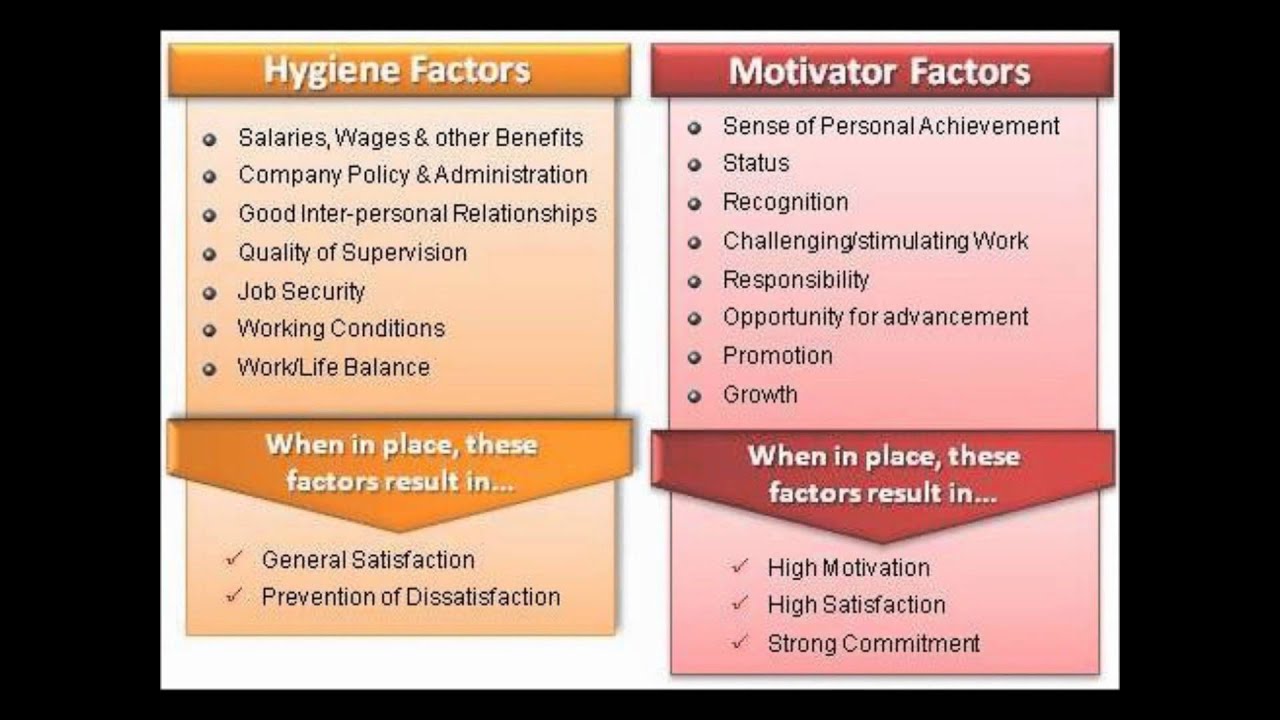
. The two-factor theory also known as Herzbergs motivation-hygiene theory states that there are certain factors in the workplace that cause job satisfaction while a separate set of factors cause dissatisfaction. These two factors are both critical to motivation. That is intrinsic motivators tend to increase motivation when they are present while extrinsic motivators tend to reduce motivation when they are absent.
Motivation is a general term that refers to the entire class of drives desires needs wishes and similar forces that compel people to choose certain options over others Maicibi 2003. According to Herzberg intrinsic motivators and extrinsic motivators have an inverse relationship. According to Herzberg motivation hygiene theory which one of the following is a motivating factor.
Motivators and hygiene factors see Figure 1. According to Herzbergs two-factor theory of motivation which of the following is a motivator. This video reinforces the statement in this chapter that says people are.
An opportunity to show what you can do e. Two factor theory is also known as. The work itself.
Herzbergs two-factor theory outlines that humans are motivated by two things. Motivator factors These factors are directly connected to the job and it is the satisfaction that an employee gains through engagement of hisher duties and responsibilities pertaining to the job or the job role Haruna 2013According to Ball 2003 job satisfaction can be increased by follows The employees should feel a sense. In 1959 Herzberg conducted a study on the job attitudes for 203 accountants and engineers.
According to the three-needs theory Gabriela has a. A number of research efforts have been undertaken to replicate the two-factor theory and in the main they support Herzbergs findings. SourceHerzberg 2005 1.
Two Factor theory Herzberg According to Herzberg two kinds of factors affect motivation and they do it in different ways. 2 pts 10 of 75 27 complete is Test 150 pt According to Herzbergs two-factor theory which one of the following is a hygiene factor. Responsibility A Click to select your answer JavascriptdoExercise 101.
The two-factor theory has been introduced by Herzberg by examine the peoples different responses to the question of the situations where they feel good and bad about their jobs Dartey-Baah Amoako 2011Based on that it was identified that there are certain factors which are related with job satisfaction and there are some other factors which are related with. If a manager has a. Application of Frederick Herzbergs Two-Factor theory in assessing and understanding.
Achievement power affiliation is three important needs that explain motivation is. She especially relishes the one-on-one time that she has with students during academic advising. According to Herzbergs two-factor theory which of the following is a hygiene factor.
Are things such as challenging work assignments accomplishment and personal recognition and autonomy that can create job satisfaction. And Ogunlana SO 2003 motivation factors are the six job content factors that include achievement recognition work itself responsibility advancement and possibility of growth. Achievement recognition responsibility meaningful and challenging work growth and advancement.
These are factors whose absence motivates but whose presence has no perceived effect. Following are the four basic categories of theory developed for. They are things that when you take them away people become dissatisfied and act to get them back.
Two factor theory was given by. According to Herzberg cited in Ruthankoon R. According to Herzbergs two-factor theory which of the following would be considered a motivator.
On the other hand hygiene factors do not lead to higher motivation and positive satisfaction in the long term. It was developed by Frederick Herzberg a psychologist who theorized that job satisfaction and job dissatisfaction. Herzberg would call this a concentration on ________ factors.
According to Herzberg the opposite of Satisfaction is No satisfaction and the opposite of Dissatisfaction is No. The needs of the employees are categorized into two groups by Herzberg as one group of needs require to develop the personal occupation as a source of growth. B Cross-Cultural Job-Satisfaction Studies.
According to Herzbergs two factor theory motivational factors are pertaining to the job content which. Motivators encourage job satisfaction and hygiene factors prevent job dissatisfaction. Doug Radi described an example where Rudis Bakery took the stress level of one of its employees into consideration and revised her job to minimize the stress.
In Herzbergs two-factor theory 1. Herzberg states the following to be motivating factors. Chapter 12 - Motivation Across Cultures International Findings of Herzbergs Theory 1 International findings on Herzbergs theory fall into two categories.
Motivation involves internal and external forces that influence a persons choice of action.
Herzberg Two Factor Theory What Is Human Resource Two Factor Theory Herzberg What Is Human

Two Factor Theory Of Motivation Motivators Hygiene Factors Motivation Theory Two Factor Theory Herzberg Motivation Theory
Chapter 5 Theories Of Motivation Herzberg Theory Of Motivation Motivation Theory Herzberg Motivation Theory Motivation

Herzberg S Two Factor Theory Organizational Behavior And Human Relations Two Factor Theory Organizational Behavior Herzberg

Comments
Post a Comment